
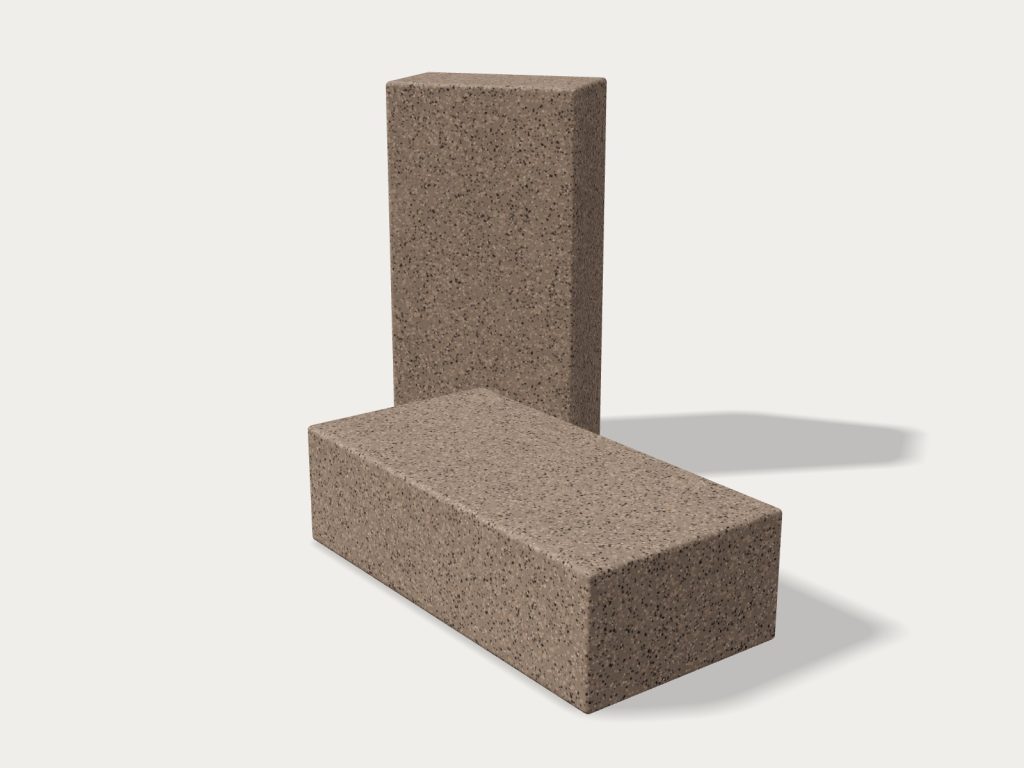
Magnesia refractories
Magnesia-chrome brick
Magnesia brick with added chromite for roofs of electric steelmaking furnaces and the hot zone of rotary kilns. Withstands high temperature and swings between heats.
- Type
- Shaped refractory, brick
- Base
- Periclase and chromite
- Grades
- PKhSP, PKhSUT, PKhSU, PKhSS, PKhSST; PKhTs
- Application
- Electric furnace roofs, non-ferrous furnaces, cement kilns
- Shape
- Straight brick, end and side wedges
- Standard
- GOST 10888-93, GOST 21436-2004
Description
Magnesia-chrome brick is made from sintered periclase (MgO) with added chromite ore. It contains more periclase than chromite: at least 65–70 % magnesium oxide and 7–18 % chromium oxide Cr₂O₃. During firing, chromite forms spinel that firmly bonds the periclase grains. As a result, the product resists thermal shock and slag better than pure periclase brick. When there is more chromite than periclase, the product is called chrome-magnesia brick: these are the KhP grades. Magnesia-chrome brick holds high temperature under load and shows little shrinkage in the roof.
For roofs of steelmaking furnaces GOST 10888-93 sets five grades, often referred to together as PKhS. PKhSP (dense) and PKhSUT (compacted, thermal-shock-resistant) are for roofs of large furnaces and electric furnaces from 50 t. PKhSU (compacted) is for electric furnaces up to 50 t. PKhSS (medium-density) is for furnaces with moderate oxygen blowing. PKhSST (medium-density, thermal-shock-resistant) is for roofs of ports, slag pockets and regenerators. In Russian the grades are written ПХСП, ПХСУТ, ПХСУ, ПХСС and ПХССТ. The grades are interchangeable; the choice depends on the tonnage and operating mode of the furnace.
For rotary kilns there is a separate grade, PKhTs (ПХЦ) to GOST 21436-2004, installed in the burning zone. In a cement kiln, chromium from the brick can turn hexavalent and pass into the clinker, so for new linings we recommend chrome-free periclase-spinel brick and supply PKhTs at the customer’s request. Magnesia-chrome brick also works in smelting furnaces and converters in non-ferrous metallurgy.
Products to GOST 10888-93 carry shape numbers: Nos. 1–8 are straight bricks, Nos. 9–27 are end wedges, followed by side, transition and skewback shapes. For example, PKhSS-6 is a straight brick of grade PKhSS, and PKhSS-9 is an end wedge. We supply straight brick, wedges and products to drawing. Store the brick on pallets in a dry, covered area: periclase is sensitive to moisture. We will select the grade and shape numbers for your roof from the drawing or your previous specification.
Technical data
| Property | PKhSP | PKhSUT | PKhSU | PKhSS | PKhSST |
|---|---|---|---|---|---|
| MgO content, %, min | 70 | 70 | 65 | 65 | 65 |
| Cr₂O₃ content, % | 7–15 | 7–15 | 7–15 | 7–15 | 7–18 |
| Apparent porosity, %, max | 16 | 18 | 20 | 22 | 22 |
| Cold crushing strength, N/mm², min | 37.5 | 35.0 | 32.5 | 27.5 | 25.0 |
| Refractoriness under load (onset of softening), °C, min | 1560 | 1540 | 1540 | 1520 | 1500 |
| Thermal shock resistance (1300 °C — water), cycles, min | 4 | 6 | 5 | 3 | 5 |
| Permanent linear change (1650 °C, 3 h), shrinkage, %, max | 0.7 | 0.7 | 0.8 | 0.9 | 0.9 |
For rotary kilns: PKhTs
| Property | PKhTs |
|---|---|
| MgO content, %, min | 65 |
| Cr₂O₃ content, % | 8–18 |
| Apparent porosity, %, max | 24 |
| Cold crushing strength, N/mm², min | 25 |
| Refractoriness under load (onset of softening), °C, min | 1500 |
| Thermal shock resistance (1300 °C — water), cycles, min | 8 |
Applications
Related products
Request a quote
Give the quantity or kiln dimensions and a consultant will get back to you.
+7 778 775-22-55