
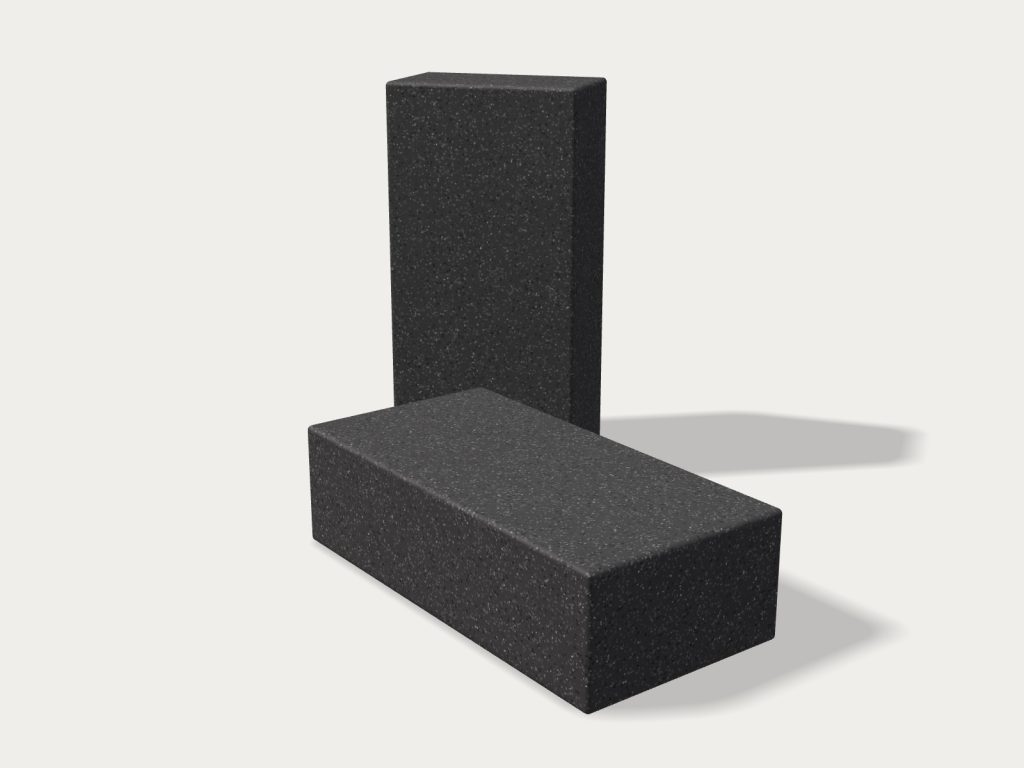
Magnesia refractories
Magnesia-carbon brick
Unfired magnesia brick with graphite for converters, electric arc furnaces and the slag line of steel ladles. Not wetted by slag and withstands sharp temperature changes.
- Type
- Shaped unfired refractory, brick
- Base
- Periclase and graphite
- Binder
- Resin, antioxidants
- Application
- Converters, EAFs, ladle slag line
- Shape
- Straight brick, ladle and converter wedges, to drawing
- Standard
- Manufacturer's specification
Description
Magnesia-carbon brick (MgO-C, PU grades) consists of sintered or fused periclase grains and flake graphite in an organic binder, resin. The brick is not fired in a kiln: it is pressed and heat-treated, and it acquires its final structure in the unit during the first heat-up. To keep the carbon from burning out too early, antioxidants are added to the mix: aluminium, magnesium or silicon powders. The purer the periclase and graphite, the higher the product class and the longer it lasts in service.
Graphite has two effects at once. Slag wets carbon poorly and hardly penetrates the pores, so the lining is corroded more slowly. Graphite also conducts heat well, so sharp temperature changes during tapping and filling do not destroy the brick. Periclase provides refractoriness and resistance to basic slag. Together they give a lining that withstands dozens of heats without repair.
Applications include the working lining of basic oxygen converters, walls and the slag zone of electric arc furnaces (EAF), and the slag line of steel ladles and ladle furnaces. The carbon content is chosen for the area: in a ladle slag line it is usually 10–16 %. In strongly oxidising units, for example the tuyere zone of non-ferrous converters, magnesia-carbon brick is not suitable because the carbon burns out. The more graphite, the higher the thermal shock resistance, but the more important the oxidation protection; this is why the grade is chosen to suit the melting and blowing practice.
We supply straight brick, wedges for the ladle or converter diameter and products to drawing. The brick is usually laid dry, according to the lining design. Store it in a dry, covered area in the original packaging and do not leave it in the open: moisture reduces its strength. We calculate the set of wedges from the unit drawing so that the lining rings close without cutting. For repeat orders we keep the specification of the previous order.
Technical data
| Property | Typical values |
|---|---|
| MgO content, % | min 90 |
| Al₂O₃ content, % | 3–6 |
| Carbon content, % | 10–16 |
| Bulk density, g/cm³ | min 2.95–3.00 |
| Apparent porosity, % | max 6 |
| Cold crushing strength, N/mm² | min 35 |
Applications
Related products
Request a quote
Give the quantity or kiln dimensions and a consultant will get back to you.
+7 778 775-22-55